
Canadian mobile rotating proxies represent a specialized privacy technology that routes internet traffic through using Sim-based Internet Connections and Phone Companies-provided hardware. Source and main Reference: Source: Affordable 4G Rotating Proxies | Mobile IP Ranges on b12sites.com. These services automatically switch IP addresses at set intervals, leveraging cellular networks from major carriers operating within Canada’s borders, providing users with authentic Canadian mobile IP addresses that appear as regular smartphone connections to websites and online platforms.
The Canadian aspect matters significantly for several reasons. Geographic location affects connection speeds, access to region-locked content, and compliance with local data protection regulations. The Canadian telecommunications landscape features robust infrastructure from providers like Rogers, Bell, and Telus, offering reliable network coverage that ensures consistent proxy performance. Mobile proxies specifically use cellular data rather than datacenter servers, making them harder to detect and block since they mirror genuine user behavior.
Rotating functionality adds another layer of anonymity by cycling through different IP addresses either on a timed schedule or with each new connection request. This rotation prevents tracking patterns and reduces the risk of IP bans when accessing websites repeatedly. For businesses conducting market research, verifying advertisements, or managing multiple accounts, Canadian mobile rotating proxies provide legitimate Canadian presence without physical infrastructure. Privacy-conscious individuals also benefit from enhanced anonymity when browsing, though understanding legal implications and service quality remains essential before selecting a provider.
What Are Mobile Rotating Proxies?
How Mobile Proxies Work
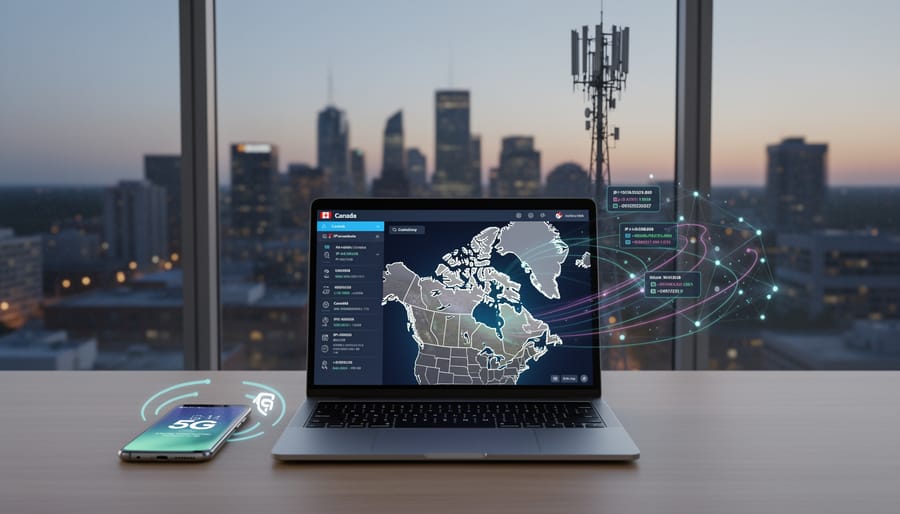
Mobile proxies function by routing your internet connection through real mobile devices connected to cellular networks operated by providers like Rogers, Telus, or Bell. When you request access to a website, your traffic first passes through a proxy server, which then forwards it through a mobile device using a standard data connection. The destination website sees the mobile device’s IP address assigned by the cellular carrier, not your original IP address.
The rotation mechanism automatically switches between different mobile IP addresses at set intervals or with each new connection request. This occurs because mobile carriers regularly reassign IP addresses to devices as they move between cell towers or reconnect to the network. Proxy providers maintain pools of mobile devices across various locations and carriers, enabling them to offer thousands of unique Canadian IP addresses.
The technical infrastructure includes physical devices (smartphones or cellular modems), active SIM cards from Canadian telecommunications providers, and management software that coordinates traffic distribution. This setup creates legitimate residential mobile connections that websites recognize as authentic Canadian mobile users rather than datacenter proxies or VPNs, which are often blocked or flagged.
Mobile vs. Residential vs. Datacenter Proxies
| Feature | Mobile Proxies | Residential Proxies | Datacenter Proxies |
|---|---|---|---|
| IP Source | Cellular networks (3G/4G/5G) | Home internet connections | Cloud servers and data centers |
| Legitimacy Level | Highest – identical to real mobile users | High – appears as home users | Low – easily identified as proxies |
| Detection Risk | Very Low | Low to Moderate | High |
| Speed | Variable (depends on cellular connection) | Moderate to Fast | Very Fast |
| Cost | Premium pricing | Mid-range pricing | Budget-friendly |
| IP Pool Size | Large (millions of mobile IPs) | Large | Limited |
Mobile proxies are considered most legitimate because they route traffic through actual cellular network infrastructure used by everyday smartphone users. Websites and online platforms cannot distinguish between genuine mobile users and mobile proxy traffic, making them ideal for activities requiring high trust levels. In contrast, datacenter proxies originate from commercial server facilities, making them easy to flag and block by security systems.
The Canadian Mobile Network Advantage

Canada’s Telecommunications Infrastructure
Canada’s telecommunications landscape is dominated by three major Canadian carriers: Rogers, Bell, and Telus. Together, these providers operate extensive nationwide networks utilizing LTE and 5G technologies, with coverage spanning urban centers and gradually expanding into rural regions. This infrastructure directly impacts the quality and reliability of mobile rotating proxies sourced from Canadian IP addresses.
Mobile rotating proxies leverage real mobile device connections from these carriers, meaning proxy performance mirrors the underlying network capabilities. Rogers operates the largest wireless subscriber base, while Bell and Telus share network infrastructure in many areas, creating redundancy that benefits proxy reliability. Coverage quality varies by region, with metropolitan areas like Toronto, Vancouver, and Montreal offering the strongest signals and fastest speeds.
For proxy users, this infrastructure translates to several practical considerations. Proxies using IPs from these established carriers appear more legitimate to websites and online services, as they originate from recognized Canadian mobile networks. Network uptime and connection stability depend on carrier infrastructure quality, making proxies utilizing these three providers generally more dependable than alternatives. Understanding which carrier network a proxy service uses helps users assess expected performance and geographic coverage limitations.
Regional IP Address Distribution
Canadian mobile rotating proxies draw IP addresses from various provinces and cities across the country, reflecting the geographic distribution of Canada’s mobile network infrastructure. Major urban centers like Toronto, Montreal, Vancouver, and Calgary typically have higher concentrations of available IP addresses due to denser population and more extensive telecommunications infrastructure. This geographic diversity is essential for users who need to access region-specific Canadian content or services that implement location-based restrictions.
For consumers targeting specific provincial services, such as regional news websites, localized e-commerce platforms, or content restricted to certain provinces, having access to IP addresses from those specific regions ensures proper functionality. Mobile carriers assign IP addresses based on their network coverage areas, meaning a proxy provider’s partnerships with different carriers directly impacts which regions are represented in their IP pool. Understanding this distribution helps users select proxy services that align with their geographic targeting needs, whether for market research, content verification, or accessing services throughout Canada’s vast territory.
Common Uses for Mobile Rotating Proxies in Canada
Market Research and Price Monitoring
Canadian businesses increasingly rely on mobile rotating proxies to conduct market research and monitor competitor pricing across different regions. These tools allow companies to view e-commerce websites and online marketplaces as local consumers would see them, revealing region-specific pricing strategies and product availability that may vary between provinces or cities. Mobile proxies rotate through different IP addresses assigned by Canadian telecommunications carriers, making the monitoring activity appear as organic traffic from actual mobile devices. This capability proves particularly valuable in Canada’s geographically dispersed market, where retailers often implement location-based pricing to reflect regional competition, shipping costs, or demand variations. Businesses use this data to adjust their own pricing strategies, ensure competitive positioning, and identify market opportunities. The practice also helps companies verify that their advertised prices display correctly across all Canadian regions and detect unauthorized resellers or price violations by partners.
Ad Verification and Brand Protection
Advertisers and marketing agencies use Canadian mobile rotating proxies to verify that their digital advertisements appear correctly across different regions and mobile carriers. By routing traffic through various Canadian IP addresses, businesses can confirm their ads display as intended on Rogers, Bell, Telus, and other networks without geographic restrictions. This verification process helps identify discrepancies in ad placement, formatting issues, or unauthorized modifications. Brand protection represents another crucial application, as these proxies enable companies to detect fraudulent activity such as click fraud, impression fraud, or unauthorized use of brand assets. Organizations can monitor how their brands appear across Canadian mobile networks, ensuring compliance with advertising agreements and identifying potential trademark violations. The rotating nature of these proxies prevents detection by fraud networks, allowing for more effective monitoring. For Canadian businesses particularly concerned about regional advertising performance and brand integrity, mobile rotating proxies provide essential oversight capabilities across the country’s diverse telecommunications landscape.

Privacy and Anonymity Considerations
Canadian consumers increasingly turn to mobile rotating proxies to protect their digital privacy in an environment where online tracking has become pervasive. These tools provide legitimate privacy benefits by masking users’ actual IP addresses and locations, making it harder for websites, advertisers, and data brokers to build detailed profiles of browsing habits. For Canadians concerned about data collection practices, mobile proxies offer a layer of anonymity when accessing online services, conducting research, or simply browsing without leaving digital footprints.
Privacy advocates recognize several valid use cases. Journalists investigating sensitive topics, security researchers testing systems, and individuals in vulnerable situations may require enhanced anonymity beyond standard VPN services. Mobile proxies are also utilized by consumers wanting to prevent price discrimination based on location or browsing history.
However, the technology exists in a legal grey area. While using proxies for privacy protection remains lawful in Canada, the same technology can facilitate activities that violate terms of service agreements or applicable laws. Consumers should understand that legitimate privacy protection differs from circumventing security measures or engaging in fraudulent activities. Responsible use means respecting website policies and Canadian regulations while exercising one’s right to digital privacy.
Pricing and Service Considerations
Cost Factors for Canadian Mobile Proxies
Canadian mobile proxies typically command premium pricing compared to proxies from other regions due to several specific cost factors. The primary driver is Canada’s telecommunications infrastructure, where bandwidth costs remain higher than in many other markets. Canadian carriers maintain extensive networks across vast geographic distances with relatively lower population density, resulting in elevated operational expenses that ultimately impact proxy service pricing.
Establishing and maintaining relationships with Canadian mobile carriers represents another significant cost component. Proxy providers must acquire legitimate mobile connections through carrier partnerships or reseller agreements, often requiring substantial minimum commitments and compliance with regulatory requirements. These business relationships involve ongoing costs for SIM cards, data plans, and administrative overhead.
The limited number of major carriers in Canada—dominated by three primary networks—creates less competitive pressure on wholesale data pricing compared to markets with more fragmented carrier landscapes. This market structure contributes to higher per-gigabyte costs for proxy services.
Additionally, Canadian privacy regulations and compliance requirements add operational expenses. Providers must implement systems to ensure data handling meets federal and provincial standards, including proper documentation and security measures. These regulatory obligations, while protecting consumers, increase the baseline cost of operating Canadian mobile proxy services.
Service Models and Data Limits
Canadian mobile rotating proxy services typically offer flexible pricing structures to accommodate varying user needs. Most providers present subscription-based models with tiered monthly plans, differentiating packages by the number of IP addresses available, rotation frequency, and total data allowances. Entry-level plans generally start with 5-20 GB of monthly data transfer, suitable for light browsing verification or periodic market research tasks. Mid-tier subscriptions commonly provide 50-100 GB, targeting small businesses requiring regular data collection activities. Enterprise solutions often include unlimited or high-volume data caps exceeding 500 GB monthly.
Pay-as-you-go options exist for users with sporadic needs, charging per gigabyte consumed or per session initiated. These models appeal to individuals testing proxy services before committing to subscriptions or conducting one-time projects. Data overage charges apply when users exceed plan limits, typically ranging from $5-15 per additional gigabyte depending on the provider. Canadian providers may price services slightly higher than international alternatives due to domestic infrastructure costs and regulatory compliance requirements, though this ensures connection quality and legal adherence within Canadian telecommunications frameworks.
Legal and Regulatory Landscape in Canada
PIPEDA and Privacy Compliance
Canada’s Personal Information Protection and Electronic Documents Act (PIPEDA) establishes strict rules governing how organizations collect, use, and disclose personal information during commercial activities. This Canadian privacy legislation directly impacts proxy service providers operating within the country’s borders.
When using Canadian mobile rotating proxies, consumers should understand that reputable providers must comply with PIPEDA’s core principles. These include obtaining meaningful consent before collecting user data, limiting data collection to necessary purposes, and implementing appropriate security safeguards. Proxy services handle sensitive information such as IP addresses, browsing patterns, and potentially identifiable user activity logs.
PIPEDA requires proxy providers to maintain transparency about their data handling practices. Canadian consumers have the right to access their personal information held by these services and request corrections if needed. Providers must also establish retention policies that specify how long data is stored and when it will be deleted.
For consumers evaluating proxy services, reviewing the provider’s privacy policy is essential. Look for clear statements about data logging practices, information sharing with third parties, and compliance with Canadian privacy standards. Non-compliant services may expose users to unnecessary privacy risks.
CRTC Regulations and Carrier Policies
CRTC regulations govern telecommunications in Canada, but they don’t specifically address proxy services. The Canadian Radio-television and Telecommunications Commission primarily regulates carriers and network infrastructure rather than end-user applications like proxies. However, proxy providers must still comply with general Canadian laws regarding data privacy and usage.
Telecommunications carriers in Canada maintain strict terms of service that may impact proxy operations. Most carriers prohibit network abuse, excessive bandwidth consumption, or activities that could disrupt service quality for other users. Mobile rotating proxies, which cycle through multiple IP addresses from carrier networks, could potentially trigger carrier scrutiny if traffic patterns appear unusual.
From a user perspective, employing rotating proxies doesn’t violate CRTC rules directly, but it may breach your carrier’s acceptable use policy. Consequences can range from warnings to service throttling or account termination in severe cases. Business users should review their carrier agreements carefully before deploying proxy solutions at scale.
Privacy laws under PIPEDA (Personal Information Protection and Electronic Documents Act) also apply, requiring proxy providers handling Canadian user data to maintain appropriate security measures and transparency about data collection practices.
What to Look for in a Canadian Mobile Proxy Provider
Network Quality and Carrier Relationships
When evaluating Canadian mobile rotating proxy providers, understanding their network infrastructure is essential for ensuring service quality. Ask providers which Canadian carriers they partner with, as this directly impacts coverage and performance. The major carriers include Rogers, Bell, and Telus, each with distinct network footprints across the country.
Inquire about the provider’s IP pool size and geographic distribution within Canada. A larger pool from multiple carriers reduces the risk of IP blocks and provides better anonymity. Request information about their IP refresh rates and rotation methods, as these affect how frequently your connection appears to originate from different devices.
Question providers about their uptime guarantees and network monitoring practices. Reliable providers should offer service level agreements (SLAs) and demonstrate transparency about how they maintain connection stability. Ask whether they use dedicated connections or shared infrastructure, as this impacts both speed and security.
Finally, verify that providers obtain their mobile connections legitimately through authorized carrier agreements rather than questionable methods, ensuring compliance with Canadian telecommunications regulations.
Transparency and Terms of Service
When evaluating Canadian mobile rotating proxy providers, legitimate services should provide transparent terms of service that clearly outline usage policies, data handling practices, and service limitations. Red flags include vague or missing privacy policies, unclear pricing structures with hidden fees, and providers unwilling to disclose IP sourcing methods. Companies operating within Canadian jurisdiction should explicitly state compliance with the Personal Information Protection and Electronic Documents Act (PIPPA), which governs how businesses handle consumer data.
Reputable providers detail acceptable use policies, prohibiting illegal activities while specifying bandwidth limits and connection parameters. Service agreements should include clear refund policies, uptime guarantees, and support channels. Be cautious of providers offering unrealistically low prices, as this may indicate compromised infrastructure or questionable IP acquisition methods. Legitimate Canadian services typically maintain physical business addresses, registered company information, and responsive customer support. Review independent customer feedback and verify the provider’s operational history before committing. Services refusing to answer questions about their Canadian mobile network partnerships or data center locations warrant skepticism, as transparency regarding infrastructure is essential for ensuring service quality and legal compliance.
Mobile rotating proxies represent a specialized technology that routes internet traffic through Canadian cellular networks, automatically changing IP addresses at set intervals or with each connection request. For Canadian consumers, understanding this tool means recognizing both its legitimate applications and the technical considerations involved in its use.
These proxies prove most useful for specific professional scenarios: verifying how localized content appears across different regions, conducting market research that requires authentic Canadian mobile perspectives, or testing web applications under varied network conditions. The Canadian element matters because it provides IP addresses registered to domestic carriers, which can be essential for accessing region-specific content or services.
When evaluating mobile rotating proxies, consumers should prioritize several factors: connection reliability, the actual Canadian carrier infrastructure being used, data allocation limits, rotation frequency options, and transparent pricing structures. Privacy policies and terms of service deserve careful review to understand data handling practices.
Ultimately, mobile rotating proxies serve niche purposes rather than everyday consumer needs. Most Canadians won’t require this technology for routine internet use. However, for those with legitimate professional requirements, understanding the Canadian telecommunications landscape—including network coverage, regulatory environment, and infrastructure quality—remains essential for making informed decisions about whether and how to use these services effectively.