
Mobile rotating proxies represent a sophisticated tool for businesses and individuals requiring dynamic IP addresses from Canadian mobile networks. These proxies automatically rotate connections through legitimate cellular carriers like Rogers, Bell, and Telus, providing authentic residential mobile IPs that are virtually undetectable by websites and services. For Canadians managing multiple accounts, conducting market research, or verifying advertisements, understanding the technology becomes essential for informed decision-making about buying 4G rotating proxy servers, which frequently put on some different IPs by design for completing tasks easily on the Internet.
The Canadian context matters significantly. Mobile proxies sourced from domestic carriers ensure compliance with local regulations, reduce latency for accessing Canadian services, and provide IP addresses that match your target audience’s geography. Unlike datacenter proxies that websites frequently block, mobile rotating proxies leverage real device connections, making them ideal for tasks requiring high trust scores and legitimate-looking traffic patterns.
This guide clarifies the technical fundamentals, evaluates key features distinguishing quality providers, and outlines practical applications relevant to Canadian users navigating an increasingly complex digital landscape.
What Are Mobile Rotating Proxies?
How Mobile IP Rotation Works
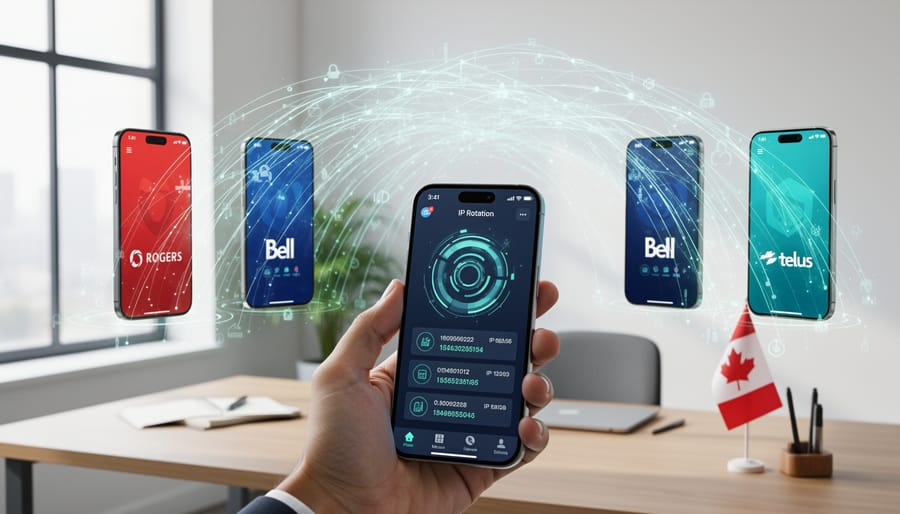
Mobile IP rotation operates by automatically cycling through different IP addresses assigned by Canadian cellular carriers like Rogers, Telus, and Bell. When you connect through a mobile rotating proxy, your internet traffic routes through devices connected to these cellular networks. Each device holds a legitimate IP address assigned by the carrier, identical to what a typical smartphone receives.
The rotation mechanism works on a time-based or request-based system. Time-based rotation switches your IP address at predetermined intervals, such as every few minutes, while request-based rotation assigns a new IP with each connection attempt. This occurs seamlessly in the background without interrupting your browsing or application usage.
Technically, the proxy service maintains a pool of mobile devices or SIM cards distributed across Canada’s cellular infrastructure. When you make an online request, the proxy server selects an available device from this pool and forwards your traffic through its cellular connection. The destination website sees only the mobile carrier’s IP address, not your original location.
This process differs fundamentally from datacenter proxies, which use static IP addresses from hosting facilities. Mobile IPs appear as genuine consumer connections because they originate from actual cellular networks, making them significantly harder for websites to detect or block as proxy traffic.
The Canadian Mobile Network Advantage
Canada’s mobile proxy infrastructure benefits from three established national carriers that provide extensive network coverage across the country. Rogers Communications, Bell Canada, and Telus collectively operate robust 4G LTE and 5G networks that span urban centers and increasingly reach rural areas, creating a reliable foundation for mobile proxy services.
These carriers maintain thousands of cell towers nationwide, which mobile proxy providers leverage to offer diverse IP addresses from legitimate residential mobile connections. When a proxy service uses IPs from these networks, the connections appear as authentic Canadian mobile users rather than data center traffic, reducing the likelihood of blocks or restrictions from websites and services.
The infrastructure quality matters significantly for proxy performance. Canada’s major carriers consistently rank among North America’s fastest networks for download speeds and latency, ensuring that mobile proxies deliver reasonable performance for activities like web scraping, market research, and accessing geo-restricted content. The competitive landscape between these three providers has driven continuous network improvements and expansion.
Mobile proxy services utilizing Canadian carrier networks provide IP addresses that rotate through various geographic locations and carrier assignments, mimicking natural mobile user behavior while maintaining connection stability necessary for automated tasks or continuous browsing sessions.
Why Location Matters: The Canada Factor
Accessing Canadian-Specific Content and Services
Canadian mobile rotating proxies serve essential purposes for accessing region-restricted content and services. Streaming platforms like CBC Gem, Crave, and TSN Direct implement geographic restrictions that require Canadian IP addresses for access. These services verify user location through IP addresses, making Canadian proxies necessary for legitimate access when traveling abroad or for businesses testing regional content delivery.
E-commerce applications represent another critical use case. Canadian retailers often display different pricing, inventory availability, and promotional offers based on visitor location. Businesses use Canadian mobile proxies to monitor competitor pricing, verify advertisement placement across provinces, and ensure their own websites display correctly for Canadian customers. This geographic verification helps maintain pricing accuracy and competitive positioning in the Canadian market.
Localized web services including banking portals, government websites, and regional news sources may restrict access to Canadian IP addresses for security and compliance reasons. Mobile rotating proxies provide the necessary Canadian presence while offering the added benefit of rotating IPs to prevent detection or blocking. The mobile designation specifically means these proxies route through actual cellular networks operated by Canadian carriers, providing more authentic residential-style IP addresses compared to datacenter alternatives. This authenticity proves particularly valuable when accessing services with sophisticated detection systems that flag suspicious connection patterns.
Canada’s Privacy and Telecommunications Regulations
Canada’s regulatory framework for telecommunications and privacy significantly influences how proxy services operate within the country. The Canadian Radio-television and Telecommunications Commission (CRTC) oversees telecommunications carriers, establishing rules that affect network access and data management. While the CRTC doesn’t directly regulate proxy services, these services must comply with regulations governing the underlying mobile networks they utilize.
Privacy protection in Canada falls primarily under the Personal Information Protection and Electronic Documents Act (PIPEDA), which sets strict standards for how businesses collect, use, and disclose personal information. Proxy providers operating in Canada must ensure their services align with PIPEDA requirements, particularly regarding user data handling and consent practices. This creates a more stringent privacy environment compared to many jurisdictions.
Additionally, Canada’s Anti-Spam Legislation (CASL) imposes requirements on electronic messaging that may affect certain proxy use cases. These regulations mean Canadian proxy services typically implement stronger privacy safeguards and transparency measures than providers in less regulated markets. For consumers, this translates to enhanced protection but may result in more rigorous verification processes when establishing proxy service accounts. Understanding these regulatory distinctions helps Canadian users select compliant providers that prioritize data protection.
Common Use Cases for Mobile Rotating Proxies in Canada
Market Research and Competitive Analysis
Canadian businesses increasingly rely on mobile rotating proxies to gain competitive intelligence while maintaining anonymity. These tools enable companies to monitor competitor pricing across e-commerce platforms without triggering anti-bot detection systems that block repeated requests from the same IP address. By routing requests through genuine Canadian mobile carrier networks, businesses can view region-specific pricing and promotional offers exactly as local customers see them.
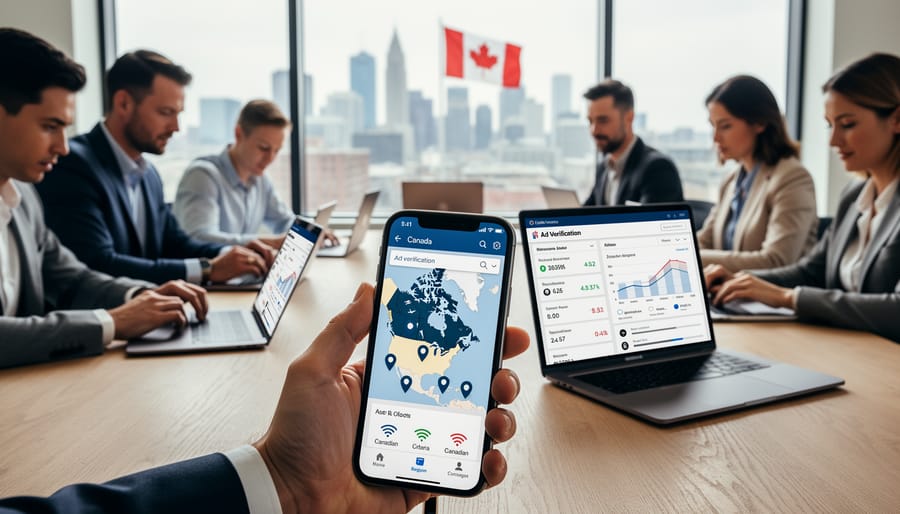
Advertisement verification represents another critical application. Marketing agencies use mobile proxies to confirm that their clients’ digital advertisements display correctly across different Canadian regions and mobile carriers. This process helps detect ad fraud, verify placement accuracy, and ensure campaigns reach intended audiences.
Market research firms utilize rotating mobile proxies to collect data from social media platforms, review sites, and online marketplaces without geographic restrictions. The technology allows researchers to gather insights about Canadian consumer behaviour, sentiment analysis, and emerging trends while appearing as legitimate mobile users. This approach provides more accurate data than traditional methods, as websites cannot distinguish proxy traffic from regular mobile browsing activity when properly configured.
Ad Verification and Brand Protection
Mobile rotating proxies enable Canadian brands to monitor how their advertisements appear across different mobile networks and geographic locations. By routing verification requests through authentic Canadian mobile IPs from major carriers like Rogers, Bell, and Telus, companies can detect fraudulent ad placements, click fraud, and unauthorized brand usage that might otherwise go unnoticed. This technology helps businesses verify that their advertising spend reaches legitimate Canadian audiences rather than bot networks. Marketing teams use rotating mobile proxies to check ad visibility from various provinces, ensuring campaigns display correctly on mobile devices and aren’t being manipulated by competitors or fraudulent publishers. For Canadian businesses investing in mobile advertising, these proxies provide essential oversight to protect brand reputation and maximize return on advertising investment across the country’s diverse mobile landscape.
Web Scraping and Data Collection
Businesses across Canada use mobile rotating proxies for legitimate web scraping and data collection activities essential to competitive intelligence. These tools enable companies to gather publicly available information from websites without triggering anti-bot detection systems that might block access. By routing requests through genuine Canadian mobile IP addresses that rotate periodically, businesses can collect market pricing data, monitor competitor offerings, and aggregate product information while appearing as regular mobile users. This approach is particularly valuable for e-commerce companies, market research firms, and price comparison services operating in Canada’s telecommunications and retail sectors. Mobile rotating proxies help maintain consistent access to public data sources, preventing IP bans that could disrupt critical business operations. When used ethically and in compliance with website terms of service and Canadian privacy regulations, these proxies serve as practical tools for gathering market intelligence that informs strategic business decisions and helps Canadian consumers access better information about products and services.
What to Look for in a Canadian Mobile Proxy Provider
Network Coverage and Carrier Diversity
Multi-carrier support is essential for mobile rotating proxies in Canada due to the country’s vast geography and diverse network infrastructure. Canadian mobile networks operate on infrastructure from major carriers including Rogers, Bell, and Telus, each with varying coverage strengths across provinces. Proxies that rotate through multiple carriers provide enhanced reliability, as network availability differs between urban centers like Toronto and remote areas in Northern Canada. This diversity also improves authenticity, as legitimate mobile users naturally connect through different carriers depending on location and device. Single-carrier proxies may trigger detection systems that recognize unusual traffic patterns. When evaluating providers, verify their carrier partnerships and geographic distribution across Canadian provinces. Providers offering access to at least two major carriers typically deliver better performance and lower blocking rates for activities requiring genuine Canadian mobile IP addresses.
Speed, Reliability, and Uptime Considerations
Mobile rotating proxies in Canada typically operate at speeds between 5-50 Mbps, depending on the underlying carrier network and current connection type (LTE vs 5G). While slower than datacenter proxies, these speeds suffice for most use cases including web scraping, social media management, and market research. However, users should expect variable latency, often ranging from 100-500ms, due to the nature of mobile networks and IP rotation processes.
Uptime reliability for Canadian mobile proxies generally reaches 95-99%, with interruptions primarily occurring during IP rotation cycles or carrier network congestion. Premium providers typically offer better stability through connections to multiple Canadian carriers (Rogers, Bell, Telus). For business-critical applications, consider providers offering automated retry mechanisms and session persistence options.
Performance varies by region within Canada, with urban centers like Toronto, Montreal, and Vancouver delivering more consistent speeds than rural areas. When evaluating providers, request trial periods to test speeds during your intended usage hours, as mobile network performance fluctuates throughout the day based on cellular traffic patterns.
Pricing Models and Cost Factors
Mobile rotating proxy providers in Canada typically offer three primary pricing structures. Data-based plans charge according to bandwidth consumption, usually ranging from $50 to $150 per gigabyte, making them suitable for users with predictable traffic needs. Time-based subscriptions provide unlimited bandwidth within a set period, with monthly costs between $300 and $800 depending on the number of concurrent connections and IP rotation speed. IP-based pricing allocates a specific number of mobile IPs, generally costing $5 to $15 per IP per day.
Canadian consumers should expect premium pricing compared to international services due to higher domestic carrier costs and smaller market scale. Entry-level packages typically start around $200 monthly for basic residential use, while business-grade solutions with Canadian mobile IPs often exceed $500 monthly. Many providers require minimum commitments of one to three months. Key cost factors include geographic targeting within Canada, carrier diversity (access to Rogers, Bell, and Telus networks), rotation frequency, and customer support quality. Trial periods or pay-as-you-go options help assess service quality before committing to longer contracts.
Potential Challenges and Limitations
While mobile rotating proxies offer significant advantages, Canadian users should consider several limitations before implementation. Speed represents a primary concern, as mobile networks typically deliver slower performance compared to residential or datacenter proxies. Mobile connections rely on cellular infrastructure, which can experience congestion during peak hours and vary significantly between urban and rural areas. LTE and 5G speeds in Canada, while improving, still face latency issues that may affect time-sensitive operations.
Cost considerations present another challenge. Mobile rotating proxies generally command premium pricing due to the expense of maintaining physical devices with legitimate mobile data plans across multiple Canadian carriers like Rogers, Bell, and Telus. Smaller businesses or individual users may find the monthly subscription fees prohibitive compared to alternative proxy solutions.
Technical challenges specific to Canadian mobile networks include limited carrier diversity in certain regions and IP pool size restrictions. Canada’s telecommunications market concentration means fewer carrier options than markets like the United States, potentially reducing IP rotation variety. Additionally, carriers may implement data throttling or impose usage restrictions that affect proxy performance.
Connection stability can fluctuate based on network conditions, tower proximity, and carrier maintenance schedules. Users requiring consistent, high-speed connections for bandwidth-intensive tasks may experience frustration with mobile proxy limitations. Furthermore, setup complexity and the need for technical knowledge to configure rotating proxies properly may discourage less experienced users. These factors require careful evaluation against specific use case requirements and budget constraints before committing to mobile rotating proxy services in Canada.
The Future of Mobile Proxies in Canada’s Telecom Landscape
Canada’s telecommunications landscape is poised for significant transformation that will directly affect mobile proxy services. The ongoing 5G network expansion by Rogers, Bell, and Telus promises faster speeds and lower latency, potentially improving proxy performance and reliability. However, these advancements may come with stricter data usage monitoring and advanced traffic analysis capabilities that could make proxy detection more sophisticated.
CRTC regulations continue evolving to balance consumer privacy rights with network management needs. Recent consultations on data portability and network access suggest potential policy shifts that could either facilitate or restrict proxy usage depending on how regulations address automated mobile connections and data routing practices. Canadian carriers are increasingly implementing machine learning systems to identify unusual traffic patterns, which may affect how mobile proxies operate on their networks.
The growing emphasis on cybersecurity and fraud prevention across Canadian telecom providers means proxy services must adapt to more stringent authentication requirements. Network slicing technology introduced with 5G could create separate virtual networks with different policies, potentially offering dedicated pathways for legitimate business proxy applications while restricting consumer access.
For businesses and consumers relying on mobile proxies, staying informed about carrier policy updates and regulatory changes will be essential. The Canadian market’s unique characteristics, including limited carrier competition and strict telecommunications oversight, will continue shaping how mobile proxy services develop and operate within legal and technical boundaries.
Mobile rotating proxies have become increasingly relevant tools for Canadian consumers and businesses navigating privacy concerns, data collection practices, and competitive market research. As the digital landscape continues to evolve, these services offer legitimate solutions for various professional applications, from price monitoring to market analysis, while providing the privacy and security benefits that many Canadians prioritize.
When evaluating mobile rotating proxy services, Canadian users should carefully assess provider reputation, connection quality from Canadian mobile carriers, compliance with Canadian telecommunications regulations, and transparent pricing structures. Understanding the distinction between residential and mobile proxies, as well as the technical limitations such as potential speed reductions and connection stability, remains essential for informed decision-making.
While these services provide valuable functionality for legitimate business operations and privacy protection, users must remain aware of their ethical responsibilities and the terms of service for websites they access. By weighing both the advantages and constraints of mobile rotating proxies, Canadian consumers and businesses can make strategic decisions that align with their specific needs while respecting legal and ethical boundaries in the telecommunications ecosystem.